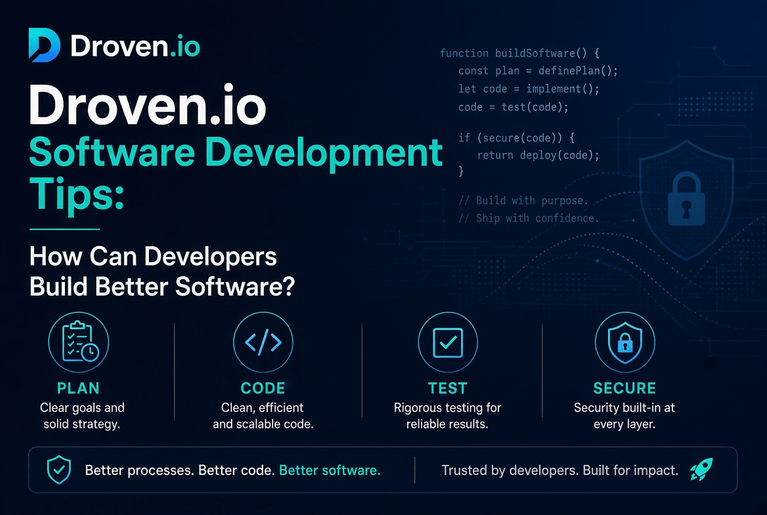
Droven.io Software Development Tips
Droven.io software development tips are practical ideas for planning, building, testing, securing, and improving software. Droven presents itself as an information hub covering software development, AI, DevOps, automation, IT education, and digital transformation.
The most useful approach is simple: understand the problem first, choose suitable tools, write maintainable code, test continuously,protect user data, and review every important change before release.
Table of Contents
Complete Details Table
| Area | Practical Tip | Main Benefit |
| Planning | Define requirements first | Clear project direction |
| Architecture | Keep systems simple | Easier maintenance |
| Coding | Write readable code | Faster teamwork |
| Git | Commit logical changes | Safer development |
| Testing | Test critical workflows | Fewer production bugs |
| Security | Protect data early | Lower security risk |
| Performance | Measure before optimizing | Better resource use |
| AI coding | Review generated code | Better accuracy |
| Documentation | Record important decisions | Easier maintenance |
| Deployment | Release carefully | Fewer failures |
| Monitoring | Watch production systems | Faster issue detection |
| Learning | Practice with real projects | Stronger skills |
What Does Droven.io Cover in Software Development?
The official Droven site describes software development as one of its main technology areas. Its coverage includes coding practices, application design, testing, debugging, performance, workflows, and related technology topics.
This makes the phrase Droven.io software development tips broader than a list of coding tricks. Good development also includes planning, collaboration, security, deployment, and long-term maintenance.
For developers, that wider view matters because working software is only one part of a successful project.
1. Start With a Clear Software Plan
One of the most useful Droven.io software development tips is to plan before writing large amounts of code.
First, define the problem. Then identify the users, required features, technical limits, and expected result.
A simple project plan can answer:
- What problem does the software solve?
- Who will use it?
- What are the essential features?
- What data does it need?
- What does success look like?
- Which features can wait until later?
Clear requirements reduce unnecessary development work. They also make testing much easier.
2. Build a Focused MVP First
A minimum viable product, or MVP, contains the smallest feature set that solves the main problem.
Avoid building every possible feature at the beginning. Extra features increase development time, testing requirements, security concerns, and maintenance work.
For example, a booking application may initially need accounts, availability, bookings, and cancellation. Advanced recommendations or complex analytics can come later.
A focused first release gives developers useful feedback before they commit to a larger architecture.
3. Choose Technology Based on the Project
Another important Droven.io software development tip is to choose technology because it fits the project, not because it is popular.
Consider:
- Team experience
- Project requirements
- Documentation quality
- Community support
- Security history
- Performance needs
- Hosting options
- Long-term maintenance
A familiar technology can often produce better results than a trendy tool that nobody on the team understands.
The right stack should solve today’s requirements while leaving reasonable room for future growth.
4. Write Clean and Readable Code
Code should be easy for another developer to understand.
Use meaningful variable names, small functions, logical file structures, and consistent formatting. Avoid clever code that saves a few lines but makes future maintenance difficult.
Readable code reduces the time needed to debug and review changes.
A useful rule is simple: write code for the next developer who must maintain it, even if that developer is you six months later.
5. Use Git From the Beginning
Version control is a core part of modern software development.
Git lets developers track changes, create branches, experiment safely, and return to earlier versions when needed. Small, logical commits also make problems easier to investigate.
GitHub explains that pull requests provide a place to propose, discuss, and review code changes before merging them.
A good workflow includes:
- Create a focused branch.
- Make a logical change.
- Test the change.
- Commit with a clear message.
- Open a pull request.
- Review the code.
- Fix issues.
- Merge after approval.
6. Test Software Throughout Development
Do not wait until launch week to test an application.
Testing should happen while features are being developed. Developers can use unit tests, integration tests, end-to-end tests, and manual testing depending on the project.
Focus first on important user journeys.
For example, an online store should carefully test account creation, product search, checkout, payment handling, order confirmation, and cancellation.
Testing early makes defects cheaper and easier to fix.
7. Build Security Into the Development Process
Security should not become a final checklist.
Protect passwords, authentication tokens, payment information, personal data, and internal system credentials from the start.
Developers should also validate user input, control access, protect APIs, update dependencies, and avoid exposing secrets in source code.
Security requirements should influence architecture and development decisions before deployment.
8. Improve Performance With Real Measurements
Performance problems can waste time when developers optimize without evidence.
Instead, measure first.
Look at response times, database queries, page loading, memory usage, CPU consumption, network requests, and other metrics that matter for the application.
Then identify the actual bottleneck.
A slow database query may need optimization, while another application may have a network or frontend problem. Measurement helps developers fix the right issue instead of guessing.
9. Debug Problems Systematically
When something breaks, avoid changing random pieces of code.
Start by reproducing the problem. Read the error message, inspect logs, identify what changed, and isolate the smallest part of the system that causes the failure.
Then test one possible cause at a time.
This approach creates a repeatable debugging process and helps developers learn from recurring problems.
Good debugging is not just about fixing today’s error. It is about understanding why the error happened.
10. Use AI Coding Tools Carefully
AI-assisted development can help with repetitive tasks, explanations, code suggestions, test ideas, and documentation.
However, generated code still needs human review.
Check:
- Logic
- Security
- Dependencies
- Error handling
- Performance
- Compatibility
- Licensing concerns
- Test coverage
Google’s guidance focuses on helpful, original, people-first content rather than content created primarily to manipulate rankings. The same principle works well for technical publishing: add genuine value instead of producing large amounts of shallow material.
AI can accelerate development, but developers remain responsible for the software they ship.
11. Review Code Before Release
Code review provides another opportunity to find mistakes before they reach users.
Reviewers should check whether the change solves the stated problem, follows project conventions, handles errors correctly, and introduces security or maintenance concerns.
GitHub recommends reviewing proposed changes through pull requests so teams can discuss and assess changes before merging.
A useful review asks:
- Does the code solve the requirement?
- Is it easy to understand?
- Are edge cases handled?
- Are tests included?
- Could the change affect another feature?
12. Document Important Decisions
Good documentation saves time.
Document setup instructions, APIs, environment variables, architecture decisions, deployment steps, and important business rules.
You do not need documentation for every line of code. Focus on information that another person would struggle to discover independently.
Keep documentation close to the project so developers can update it as the system changes.
13. Monitor Software After Launch
Deployment is not the end of development.
Real users can reveal problems that never appeared during testing. Monitor errors, response times, availability, resource usage, and important business events.
Set alerts for serious failures.
When an incident occurs, investigate the cause and record what the team learned. This creates a feedback loop that improves future releases.
How Can Beginners Apply Droven.io Software Development Tips?
Beginners should not try to master every development concept at once.
Start with one programming language and build small projects. Learn Git, basic testing, debugging, databases, APIs, and simple deployment as your projects become more advanced.
A practical learning path looks like this:
Learn → Build → Test → Break → Debug → Improve → Repeat
Hands-on practice turns theoretical knowledge into useful development skills.
How Is UploadBlog Related to Software Development Content?
Searches such as uploadblog.com, uploadblog.com page, uploadblog.com homepage, and uploadblog.com publishing platform relate to online publishing rather than software development itself.
Third-party pages describe UploadBlog as a publishing platform where users can create and share articles.
If you use a publishing platform to create a technical article, keep the article useful to readers. Avoid filling a page with repeated keywords simply to increase keyword frequency.
Can UploadBlog Help Promote Software Development Content?
Queries such as uploadblog.com business promotion, uploadblog.com write for us, uploadblog.com categories, uploadblog review, and uploadblog.com trending posts are publishing-related search terms.
Before using any third-party publishing service, verify its current submission rules, ownership, editorial policies, and contact information.
For technical articles, prioritize accuracy over publication volume.
What Is UploadBlog.com and How Does It Work?
The query what is uploadblog.com and how does it work? generally reflects an information need about publishing content online.
Likewise, searches for uploadblog.com blogspot alternative, uploadblog news, uploadblog.com in USA, and how do I submit an article on uploadblog.com? show different publishing-related intents.
These terms should remain secondary to the main subject. A software development article should still give readers practical technical value.
FAQs About Droven.io Software Development Tips
What are Droven.io software development tips?
Droven.io software development tips refers to practical guidance around planning, coding, testing, debugging, security, performance, AI-assisted development, and software workflows. Droven’s own website presents software development as one part of its broader technology coverage.
Is Droven.io software development software?
No. The available official description presents Droven as an information platform covering technology topics rather than as an IDE, programming language, or software development framework.
Are Droven.io software development tips useful for beginners?
Yes, the underlying topics can help beginners understand practical development habits. Start with basic programming, small projects, Git, testing, debugging, and simple deployment.
Why is clean code important?
Clean code makes software easier to read, test, debug, and maintain. It also helps teams understand changes without spending unnecessary time decoding complicated implementations.
Should developers use AI for coding?
Developers can use AI tools for assistance, but they should review and test generated code before using it. AI output can contain logical, security, compatibility, or maintenance problems.
How can developers improve their skills?
Build real projects, study fundamentals, read reliable documentation, review your mistakes, work with Git, test your code, and gradually learn more advanced architecture and deployment practices.
Final Takeaway
The strongest Droven.io software development tips focus on practical habits rather than shortcuts. Plan the problem carefully, build a focused MVP, write readable code, use version control, test continuously, protect data, measure performance, and review important changes.
Droven’s own technology coverage places software development alongside AI, DevOps, automation, and other modern technology subjects.
About the Author