Dense Fog Advisory
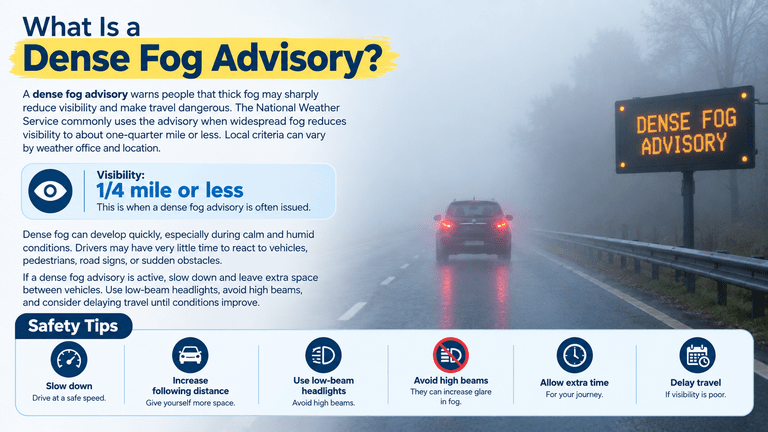
A dense fog advisory warns people that thick fog may sharply reduce visibility and make travel dangerous. The National Weather Service commonly uses the advisory when widespread fog reduces visibility to about one-quarter mile or less.
Fog can appear quickly and leave drivers with very little time to react. The safest response is to slow down, increase following distance, use low-beam headlights, and consider delaying travel until conditions improve.
Table of Contents
What Does a Dense Fog Advisory Mean?
A dense fog advisory means weather officials expect fog to create unusually poor visibility over an affected area.
The National Weather Service says these advisories are issued when widespread dense fog develops and visibility frequently falls to one-quarter mile or less. Such conditions can make driving difficult and may affect other forms of transportation.
An advisory is different from a warning that means immediate severe danger from a major storm. However, people should still take it seriously because reduced visibility can create dangerous travel conditions.
Quick meaning
Dense fog advisory = thick fog + very low visibility + increased travel risk.
When Is a Dense Fog Advisory Issued?
The exact criteria can vary by local weather office, but a common National Weather Service threshold is visibility of one-quarter mile or less across a widespread area. Some offices also include a minimum expected duration when deciding whether to issue an advisory.
Weather offices monitor several factors before issuing an advisory.
These may include:
- Expected visibility
- Geographic coverage
- Duration of the fog
- Road and travel impacts
- Temperature and moisture
- Local terrain
- Expected changes in weather conditions
Because local criteria can differ, always read the advisory issued for your specific area.
Why Does Dense Fog Become Dangerous?
The main danger is reduced visibility.
A driver may see only a short section of road ahead. That leaves less time to recognize another vehicle, pedestrian, animal, road obstruction, curve, intersection, or sudden traffic slowdown.
Fog can also create a visual illusion. Bright headlights can reflect off tiny water droplets and produce glare, making the road ahead harder to see.
The National Weather Service recommends slowing down, maintaining extra distance, and using low-beam headlights when driving in fog.
How Does Fog Form?
Fog is made of tiny water droplets suspended close to Earth’s surface.
It forms when air near the ground becomes saturated with water vapor. Cooling the air can cause water vapor to condense into tiny droplets, creating the cloud-like layer we experience as fog.
Different weather patterns can create fog.
Common types include:
- Radiation fog
- Advection fog
- Valley fog
- Freezing fog
- Evaporation fog
Local geography also matters. Valleys, low areas, wetlands, lakes, and locations near water can experience conditions that favor fog formation.
What Should You Do During a Dense Fog Advisory?
The safest approach is to avoid unnecessary travel when visibility becomes extremely poor.
If you must travel, prepare before leaving.
Before driving
- Check the latest weather forecast.
- Review local road conditions.
- Allow extra travel time.
- Clean your windshield and mirrors.
- Make sure your headlights work.
- Check that your windshield wipers work properly.
- Remove unnecessary distractions.
- Tell someone about significant travel delays if appropriate.
The National Weather Service specifically recommends considering delayed travel when a dense fog advisory is active.
How Should You Drive in Dense Fog?
If driving cannot be avoided, reduce your speed and create more space between your vehicle and the vehicle ahead.
Use low-beam headlights. High beams can reflect from fog droplets and create additional glare, making visibility worse.
Follow the road markings carefully. Avoid unnecessary lane changes and passing.
The goal is simple: drive at a speed that allows you to stop within the distance you can actually see.
Essential driving rules
- Slow down.
- Use low-beam headlights.
- Increase following distance.
- Avoid high beams.
- Avoid unnecessary passing.
- Stay focused on road markings.
- Expect sudden changes in visibility.
- Do not use cruise control in severe fog.
- Pull over safely if visibility becomes extremely poor.
- Wait for conditions to improve when possible.
Should You Use Hazard Lights in Dense Fog?
Hazard lights should not replace proper headlights while you are driving.
If visibility becomes extremely poor and you need to stop, the National Weather Service advises moving to a safe location such as a parking area when possible. In situations where you must stop at the roadside, it provides specific guidance involving hazard flashers and positioning the vehicle safely away from traffic.
The safest choice is always to get completely away from moving traffic if you need to stop.
Do not stop suddenly in an active traffic lane simply because visibility has decreased.
Can Dense Fog Cause Flight Delays?
Yes.
Fog can reduce visibility around airports and affect aircraft operations. Aviation weather reports measure visibility carefully because pilots and air traffic controllers need accurate information when assessing operating conditions. The FAA identifies fog as an atmospheric obstruction that can significantly reduce visibility.
A flight may therefore experience:
- Delays
- Holding patterns
- Changed departure times
- Changed arrival procedures
- Diversions
- Cancellations in severe situations
The exact effect depends on the airport, aircraft, runway equipment, weather conditions, and operational rules.
Passengers should check their airline and airport directly instead of assuming every fog event will cancel flights.
Does Dense Fog Affect Roads and Highways?
Yes. Roads can become significantly harder to navigate when visibility drops.
The biggest risk comes from the reduced distance available to identify hazards and react.
Drivers may have difficulty seeing:
- Brake lights
- Road signs
- Lane markings
- Pedestrians
- Motorcycles
- Animals
- Stopped vehicles
- Curves
- Intersections
- Construction areas
Fog can also vary sharply over short distances. A clear road can suddenly become heavily foggy near a bridge, valley, open field, or low-lying area.
The National Weather Service recommends extra caution in areas where visibility can change quickly.
What Is the Difference Between Fog, Mist, and Dense Fog?
Fog and mist are related weather conditions, but visibility helps distinguish them in official weather reporting.
The FAA notes that fog is reported when visibility falls below five-eighths of a mile, while mist is used at higher visibility levels within its reporting criteria.
A dense fog advisory is more specific. It indicates that fog has become sufficiently widespread and dense to meet the local advisory criteria.
| Condition | Main Feature | Travel Concern |
| Mist | Reduced visibility but generally less severe | Moderate |
| Fog | Significant reduction in visibility | Increased |
| Dense fog | Very low visibility | High |
| Dense fog advisory | Official weather alert for dense fog | Take extra precautions |
| Freezing fog | Fog with freezing conditions | Can create additional hazards |
Definitions can vary by reporting system and local weather office.
What Is Freezing Fog?
Freezing fog occurs when tiny liquid water droplets in fog freeze when they touch exposed surfaces.
That can create ice on vehicles, roads, bridges, boats, or other surfaces.
The National Weather Service warns that freezing fog can be particularly hazardous for transportation because frozen droplets can create slippery or icy surfaces.
If temperatures are near or below freezing, do not treat a fog advisory as only a visibility issue.
Watch for possible ice as well.
How Long Does a Dense Fog Advisory Last?
There is no universal fixed duration.
The advisory remains active according to the forecast and expected conditions in the affected area. Some National Weather Service offices use duration criteria when determining whether an advisory should be issued.
Fog can disappear quickly after sunrise or continue for several hours.
Its duration depends on factors such as:
- Temperature
- Humidity
- Wind
- Cloud cover
- Ground conditions
- Terrain
- Sunlight
- Atmospheric mixing
For that reason, always check the latest local advisory instead of relying on an old forecast.
What Time of Day Is Fog Usually Worst?
Many types of fog are most common during nighttime, early morning, or around sunrise.
Radiational cooling can lower surface temperatures overnight. When the air reaches saturation, fog may form close to the ground.
However, fog does not follow one universal schedule.
Coastal locations, valleys, lakes, weather fronts, and changing winds can produce fog at other times.
The safest approach is to follow current conditions rather than assuming fog will disappear at a particular hour.
How Should Pedestrians and Cyclists Handle Dense Fog?
Drivers are not the only people affected.
Pedestrians and cyclists can become harder for motorists to see when visibility drops.
If you must walk or cycle during dense fog:
- Wear visible clothing.
- Use appropriate lights.
- Stay in designated areas.
- Avoid dark roads when possible.
- Remain alert around intersections.
- Do not assume drivers can see you.
- Give vehicles extra space.
Visibility works both ways. If you cannot see a vehicle clearly, the driver may also have difficulty seeing you.
Dense Fog Advisory Safety Checklist
Use this quick checklist before leaving home:
| Safety Step | Recommended Action |
| Weather | Check the latest local forecast |
| Advisory | Confirm whether a fog advisory is active |
| Visibility | Assess current road conditions |
| Headlights | Use low beams |
| High beams | Avoid them in dense fog |
| Speed | Reduce speed |
| Distance | Increase following distance |
| Lane changes | Keep them to a minimum |
| Passing | Avoid unnecessary passing |
| Cruise control | Do not use it in severe fog |
| Windshield | Keep it clean and clear |
| Travel plans | Consider delaying if conditions are severe |
| Emergency stop | Move completely away from traffic when possible |
| Freezing conditions | Watch for ice |
These actions align with National Weather Service fog-driving guidance.
How Can You Check a Dense Fog Advisory?
The best source is your local official weather service.
In the United States, the National Weather Service provides current alerts through its weather offices and online weather tools. Other countries use their own national meteorological agencies.
When checking an alert, look for:
- Advisory name
- Affected locations
- Start time
- End time
- Expected visibility
- Travel impacts
- Updated instructions
Do not rely only on social media posts or screenshots because weather conditions can change after a post is published.
Dense Fog Advisory vs. Fog Warning: What Is the Difference?
People sometimes use “fog warning” and “dense fog advisory” as if they mean exactly the same thing.
They may not.
Weather alert names and criteria depend on the country and weather authority. In the United States, the National Weather Service uses Dense Fog Advisory for qualifying low-visibility conditions.
This is why readers should check the terminology used by their local meteorological authority.
The important point is not the label alone. The important issue is the actual visibility and the recommended safety action.
What Should Drivers Never Do in Dense Fog?
A few mistakes can sharply increase risk.
Avoid these behaviors:
- Driving at normal speed when visibility is severely reduced
- Using high-beam headlights
- Following another vehicle too closely
- Passing without clear visibility
- Making sudden lane changes
- Stopping in an active traffic lane
- Using a phone while driving
- Assuming fog will remain equally thick
- Ignoring official travel advice
The National Weather Service recommends slowing down, using low beams, maintaining distance, and stopping in a safe location when visibility becomes extremely poor.
How Does Dense Fog Affect Business and Daily Life?
A dense fog advisory can affect more than personal travel.
Poor visibility can disrupt:
- School transportation
- Bus services
- Delivery schedules
- Freight movement
- Airport operations
- Outdoor work
- Emergency response
- Road maintenance
- Commuting
The effect depends on how thick the fog becomes and how long it remains.
Businesses can reduce disruption by monitoring official forecasts and allowing flexible travel times when severe visibility problems are expected.
Complete Dense Fog Advisory Information Table
| Question | Answer |
| What is a dense fog advisory? | An official alert for widespread dense fog that significantly reduces visibility |
| Common visibility threshold | About ¼ mile or less in many U.S. NWS offices |
| Main danger | Reduced visibility |
| Biggest travel risk | Vehicle collisions caused by limited reaction time |
| Best headlights | Low beams |
| Should high beams be used? | No, they can increase glare |
| Should you slow down? | Yes |
| Should following distance increase? | Yes |
| Should travel be delayed? | Consider delaying when conditions are severe |
| Can flights be affected? | Yes, depending on airport conditions |
| Can fog create ice? | Freezing fog can create icy surfaces |
| Does fog always occur in the morning? | No |
| How long does fog last? | It varies with weather conditions |
| Best information source | Local official weather authority |
| Main safety principle | Drive only as fast as conditions safely allow |
Frequently Asked Questions
1. What does a dense fog advisory mean?
A dense fog advisory means widespread fog is expected to reduce visibility significantly. In many National Weather Service areas, the threshold is about one-quarter mile or less.
2. Is a dense fog advisory dangerous?
Yes. Dense fog can make driving and other transportation more difficult because people have less time to see and respond to hazards. The National Weather Service recommends extra caution and considering delayed travel.
3. Should I drive during a dense fog advisory?
If travel is not necessary, consider delaying it until visibility improves. If you must drive, slow down, use low-beam headlights, increase following distance, and avoid unnecessary passing.
4. Should I use high beams in dense fog?
No. High beams can reflect from water droplets in the fog and create glare. The National Weather Service recommends low-beam headlights instead.
5. Can a dense fog advisory delay flights?
Yes. Fog can reduce visibility at airports and affect aircraft operations. The FAA treats fog as an atmospheric condition that can reduce reported visibility and influence flight operations.
6. How can I stay safe during a dense fog advisory?
Check official weather updates, delay unnecessary travel when conditions are severe, slow down, use low beams, maintain extra distance, and stop only in a safe location if visibility becomes extremely poor.
Final Thoughts
A dense fog advisory is a simple message with an important purpose: it tells you that visibility may become poor enough to change how you should travel.
The smartest response is not to panic. It is to slow down, stay alert, check official weather information, and give yourself more time.
If visibility becomes extremely poor, delaying the trip may be the safest choice. When travel cannot wait, follow official guidance and make visibility your first priority.
About the Author