The professional landscape of 2026 is unrecognizable compared to a decade ago. While the buzz usually surrounds AI and automation, there is a “silent” skill that separates the top-tier candidates from the rest: Technical Writing. For Gen Z graduates entering a competitive global market, the ability to translate complex data into clear, actionable insights isn’t just a bonus—it is a survival mechanism. Whether you are in Engineering, Healthcare, or Finance, your career trajectory will likely be determined by how well you document your ideas.
However, the transition from university essays to professional documentation is steep. Many students find that the academic tone they spent years perfecting doesn’t quite fit the fast-paced requirements of the UK industry. When the pressure of final year projects hits, it’s common to feel overwhelmed by these shifting standards. This is where professional resources like MyAssignmentHelp come into play; many students find that securing reliable assignment writing help UK allows them to see high-quality technical templates firsthand, helping them bridge the gap between student-level writing and professional-grade reporting.
The Evolution of Communication in a Digital-First Era
Gen Z has often been labeled as the “visual generation,” but in a remote-work world, text is our primary interface. In 2026, the average professional spends over 30% of their day reading or writing emails, Slack messages, and project briefs. If those communications are cluttered or vague, productivity drops. Technical writing is the art of removing that clutter. It is about precision, brevity, and knowing exactly what your audience needs to know—and nothing more.
For a graduate, this skill manifests in “User Manuals,” “Standard Operating Procedures (SOPs),” and “Project Proposals.” If you can explain a complex software update or a safety protocol in a way that a non-expert understands, you become an indispensable bridge within your company. You aren’t just an “employee”; you are a communicator who saves the company time and money.
Why Technical Writing Outranks “Soft Skills”
While empathy and leadership are vital, they are hard to quantify on a resume. Technical writing, however, provides immediate proof of your competence. It shows that you have a structured mind. When you produce a clean, well-formatted report, you are telling your manager: “I have processed this information, I have identified the risks, and I have provided a solution.” In the UK and global markets, employers are increasingly looking for “T-shaped” individuals—those who have deep technical knowledge but also a broad ability to communicate across departments.
Comparison: Academic Writing vs. Technical Writing
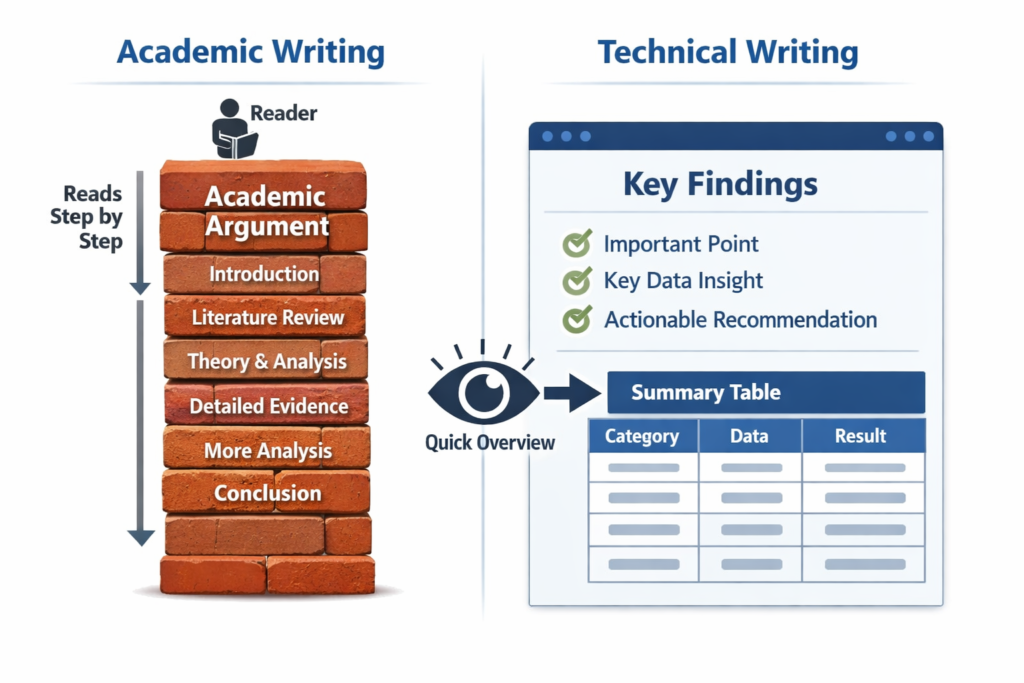
| Feature | Academic Writing | Technical Writing |
| Purpose | To demonstrate knowledge/get a grade | To trigger an action or inform a decision |
| Audience | Professors/Examiners | Users, Stakeholders, Clients |
| Tone | Formal, complex, and verbose | Direct, objective, and concise |
| Structure | Linear (Intro, Body, Conclusion) | Scannable (Headings, Bullets, Tables) |
| Visuals | Rarely used (mostly text) | Essential (Diagrams, Flowcharts, Icons) |
Navigating the 2026 Academic Pressure
The demand for high-level technical skills starts long before the first job interview. Today’s undergraduate curriculum is more rigorous than ever, often requiring students to produce industry-standard reports while still learning the core theory. It is a “double-load” that can lead to significant stress.
As a result, the “model paper” approach has become a popular strategy for top-performing students. By choosing to buy assignment online through trusted platforms like MyAssignmentHelp, students get access to structured examples that demonstrate exactly how a technical report should look. This isn’t about skipping the work; it’s about having a “Gold Standard” to follow, ensuring that your own submissions meet the strict E-E-A-T (Expertise, Authoritativeness, and Trustworthiness) criteria that modern universities now demand.
The “Scannability” Factor: Writing for the 2026 Brain
We live in an age of short attention spans. If your report is a “wall of text,” it won’t be read. Human-centric technical writing in 2026 focuses on scannability. This means:
- Using Bullet Points: Like this one, to break down complex lists.
- Short Paragraphs: Keeping ideas contained to 3-4 sentences.
- Active Voice: Saying “The team completed the test” instead of “The test was completed by the team.”
- Information Hierarchy: Putting the most important information at the top (The Inverted Pyramid).
Building Your Technical Writing Toolkit
If you want to master this skill before graduation, start by looking at your current assignments through a professional lens. Don’t just write to fill a word count; write to solve a problem.
- Audit your language: Remove “filler” words like very, really, basically, and actually.
- Learn Basic Design: Understand how white space on a page helps the reader’s brain rest.
- Peer Review: Have a friend read your work. If they have to ask “What does this mean?”, you haven’t written it technically enough.
Global Opportunities for Technical Communicators
The beauty of this skill is that it is “location-independent.” A Gen Z graduate in London can write technical documentation for a tech startup in Silicon Valley or a manufacturing firm in Singapore. Because the rules of technical logic are universal, your ability to write clearly makes you a global citizen. In a world where AI can generate “generic” content, the human ability to add context and nuance to technical data is what will keep you employed for the next thirty years.
Conclusion: Your Career’s Secret Weapon
As you navigate your undergraduate years, don’t view your writing assignments as just another hurdle to clear. View them as the training ground for your professional voice. Mastering technical writing is the ultimate “power-up” for Gen Z. It guarantees that your ideas will be heard, your projects will be approved, and your career will remain resilient in the face of an ever-changing digital economy.
Frequently Asked Questions (FAQ)
Q1: Is technical writing only for Science and Tech majors?
Absolutely not. While it’s vital for STEM, anyone in Business, Law, or the Arts needs technical writing to create contracts, business plans, or museum catalogs. If there is a process involved, there is a need for technical writing.
Q2: How does technical writing help with SEO?
Google’s 2026 algorithm prioritizes “Helpful Content.” Technical writing is naturally helpful because it is structured and factual. By using proper headings and clear language, you make it easier for search engines to understand and rank your content.
Q3: Can AI do technical writing for me?
AI is a great tool for drafting, but it often hallucinates facts or uses “fluffy” language. Human oversight is required to ensure the instructions are safe, accurate, and culturally appropriate for the target audience.
Q4: What is the biggest mistake students make in technical reports?
The biggest mistake is being too “academic.” Students often try to sound “smart” by using big words, which actually makes the document harder to use. The smartest person in the room is the one who can explain a complex concept in the simplest terms.
About The Author
I’m Julie Brown, a Senior Academic Consultant and Lead Content Strategist at MyAssignmentHelp. With over a decade of experience in the UK higher education sector, I specialize in helping students bridge the gap between complex academic theory and professional-grade execution. My work focuses on empowering the next generation of Gen Z professionals to master technical communication and navigate the evolving standards of the 2026 job market.
About the Author