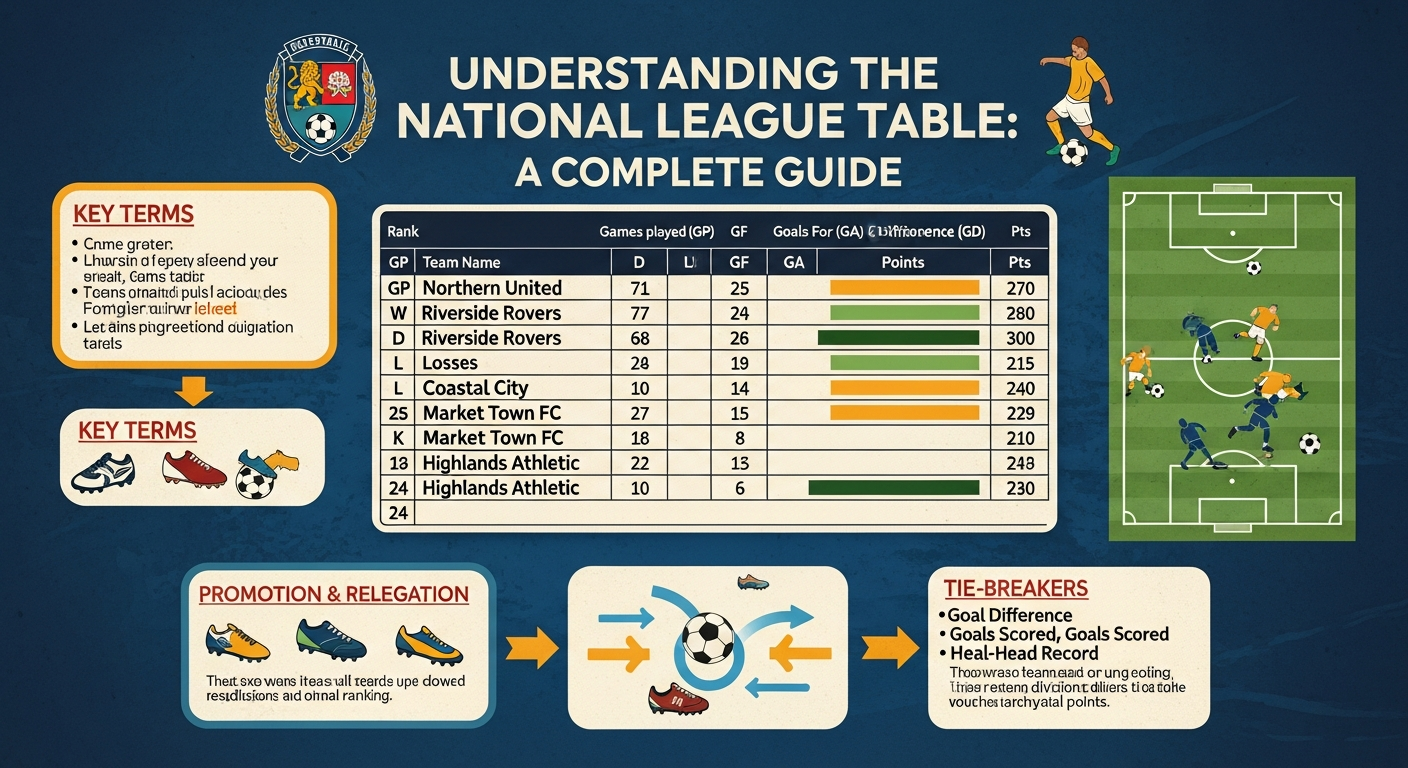
national league table
The national league table is an essential tool in the world of sports, especially in football, cricket, and other competitive leagues. It serves as a comprehensive ranking system that allows fans, clubs, and analysts to track the performance of teams over a season. Understanding how a national league table works, what it represents, and its importance can enhance your experience as a fan and provide valuable insights for those involved in the sport.
What is a National League Table?
A national league table is a ranking chart that lists teams in a particular sport based on their performance during a season. The table usually ranks teams according to points earned, with additional criteria like goal difference, wins, and head-to-head results used as tiebreakers.
National league tables are common in football leagues worldwide, including the English Football League, La Liga, and Serie A. They also appear in other sports, such as rugby, cricket, and basketball. The table serves as a snapshot of the current standings and provides a way to compare team performance.
How Points are Calculated
Points in a national league table are awarded based on match outcomes. The most common system is:
- A win typically earns a team three points.
- A draw results in one point for each team.
- A loss provides no points.
In some leagues, bonus points may be awarded for scoring a certain number of goals or for close losses, particularly in rugby. These points accumulate over the season, forming the basis of the league table rankings.
The Role of Goal Difference
When teams have the same number of points, goal difference often determines their ranking. Goal difference is calculated by subtracting the number of goals conceded from the number of goals scored. Teams with higher goal differences are ranked above those with lower differences, reflecting their ability to score more than they concede.
Key Features of a National League Table
A national league table typically includes several important elements:
- The team name.
- The number of matches played.
- The number of wins, draws, and losses.
- Goals scored and goals conceded.
- Goal difference.
- Total points.
These features make it easy to assess both the strengths and weaknesses of each team, providing insights beyond just wins and losses.
Why National League Tables Matter
National league tables are more than just a scoreboard. They influence important decisions in sports, such as:
- Promotion and relegation: In many football leagues, the top teams may be promoted to a higher division, while the bottom teams face relegation.
- Qualification for tournaments: High-ranking teams may qualify for national or international competitions.
- Sponsorship and funding: Teams that perform well often attract more sponsorship deals and fan support.
- Strategic planning: Coaches and management use the table to make tactical and strategic decisions.
For fans, league tables provide a sense of excitement and anticipation as they track their favorite teams’ journey throughout the season.
How to Read a National League Table
Reading a national league table requires understanding its structure. The table is usually organized from the team with the most points at the top to the team with the fewest points at the bottom. Each row provides essential data on team performance, allowing comparisons across the league.
It is important to look beyond the total points and consider factors such as goal difference and recent form, which may indicate a team’s future performance. Teams with a strong goal difference and consistent wins are often considered more dominant.
National League Tables in Football
In football, national league tables are especially significant. They determine which teams win the league, qualify for European competitions, or face relegation. Many leagues publish updated tables after every match, keeping fans engaged and informed.
Historically, tables have been used to track long-term trends, such as the dominance of certain teams over decades or the rise of underdog clubs. Football analysts often use league tables as a basis for predicting match outcomes and assessing team strategies.
National League Tables in Other Sports
While football is the most common sport associated with national league tables, they are also widely used in other sports. In rugby, cricket, and basketball, league tables help manage competitions and rankings.
In cricket, for example, points are awarded not only for wins and losses but also for bonus criteria such as batting and bowling performances. In basketball, rankings often take into account wins, losses, and head-to-head results. Regardless of the sport, league tables provide a structured way to measure performance and maintain competitiveness.
Limitations of National League Tables
Although national league tables are informative, they have limitations. A table may not fully reflect a team’s form, injuries, or other contextual factors. For instance, a team with many draws may appear lower in the table than a team with fewer games played but more wins.
Additionally, external factors like match postponements, weather, or refereeing decisions can influence the points accumulation and rankings. Therefore, while league tables are useful, they should be interpreted with an understanding of the broader context.
How Technology Has Changed League Tables
With the advent of digital media, national league tables are now more accessible than ever. Online platforms provide live updates, interactive visuals, and detailed statistics. Fans can track their favorite teams in real time, analyze player performances, and even compare historical data.
Technology has also enabled more sophisticated analytics, such as expected goals, possession metrics, and player efficiency ratings. These advanced statistics complement traditional league tables and offer a deeper understanding of team performance.
The Psychology Behind League Tables
League tables have a psychological impact on players, coaches, and fans. Being at the top of the table boosts confidence, motivates teams, and increases fan engagement. Conversely, being at the bottom can create pressure and urgency to improve performance.
This psychological aspect makes league tables more than just numbers; they influence morale, strategy, and overall competitiveness within the league.
Conclusion
The national league table is a vital component of modern sports. It organizes and presents team performance in a structured and accessible way. From tracking wins and losses to determining promotion, relegation, and tournament qualifications, the table plays a crucial role in sports management and fan engagement.
By understanding how to read and interpret league tables, fans and analysts can gain insights into team strengths, weaknesses, and potential future outcomes. Whether in football, cricket, rugby, or basketball, the national league table remains a cornerstone of competitive sports.
FAQs About National League Tables
1. What is the purpose of a national league table?
A national league table ranks teams based on performance during a season. It helps track points, wins, losses, and overall team standings.
2. How are points awarded in a league table?
Points are typically awarded with three points for a win, one point for a draw, and zero points for a loss. Some sports may also have bonus points.
3. What does goal difference mean in a league table?
Goal difference is calculated by subtracting goals conceded from goals scored. It is used to rank teams that have the same number of points.
4. How does a national league table affect promotions and relegations?
Teams at the top of the table may be promoted to a higher division, while those at the bottom may be relegated to a lower division, depending on league rules.
5. Can league tables predict future team performance?
While league tables provide insights into team performance, they cannot fully predict outcomes because factors like injuries, tactics, and match conditions also play a role.
About the Author