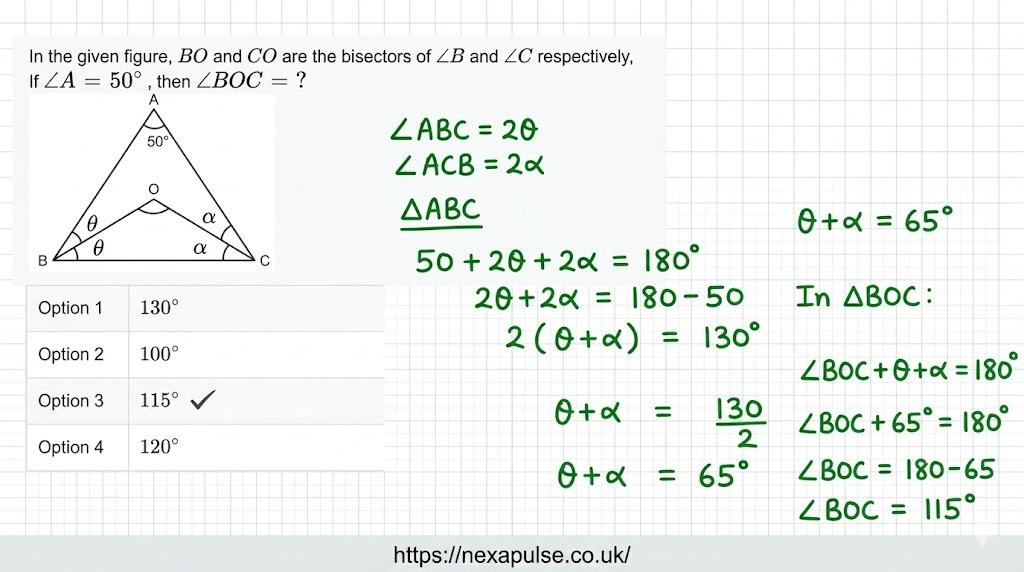
BO and CO
Geometry can feel like a tricky puzzle sometimes. Have you ever looked at a triangle problem and wondered where to start? You might see a question that says, “in the given figure BO and CO are the bisector” of angles. It sounds very complicated, but it is actually quite fun once you know the secret rules. Think of this as learning to decode a secret map. We will break this down into easy steps so you can solve these problems with confidence every single time. Let’s explore this together!
Table of Contents
What is an Angle Bisector?
An angle bisector is like a magic line that cuts an angle perfectly in half. Imagine you have a slice of pizza and you cut it into two identical, smaller pieces. That is exactly what a bisector does to an angle! When a problem states that in the given figure BO and CO are the bisector, it means these lines split the original angles into two equal parts. Understanding this simple concept is the key to unlocking many difficult geometry questions. It is the foundation for everything else we will learn today.
Why Do We Use Bisectors in Triangles?
In geometry, we love using bisectors because they create predictable patterns. When we know a line is a bisector, we can easily find the missing measurement of an angle. If the whole angle is 60 degrees, the bisector makes two angles of 30 degrees each. Problems where in the given figure BO and CO are the bisector help us see these relationships clearly. By finding these small, equal angles, we can eventually find the size of bigger angles hidden inside the triangle. It is all about connecting the pieces!
Visualizing BO and CO in Your Figure
To solve these problems, you need to draw or look at the figure carefully. Find point B and point C on your triangle. The lines BO and CO start at these corners and move toward the middle. Because in the given figure BO and CO are the bisector, you should mark the two halves of the angle with the same symbol. Using a small arc with a dot is a great way to remember they are equal. This visual trick makes the math much easier to handle.
The Relationship Between Angles
When you look at a triangle, the sum of all its inside angles is always 180 degrees. This is a golden rule in geometry. When in the given figure BO and CO are the bisector, they meet at a point inside the triangle. This creates a new, smaller triangle at the bottom! We can use the 180-degree rule to figure out the angles in this new, smaller triangle. It is like a mini-mystery waiting for you to solve it using basic addition and subtraction.
Step-by-Step Problem Solving
Let’s walk through a common problem. If you see that in the given figure BO and CO are the bisector, start by finding the top angle of the big triangle. If that angle is 80 degrees, the other two angles must add up to 100 degrees. Since the lines cut those angles in half, you can divide by two. This systematic approach is how experts solve math problems. By taking it one step at a time, you will never feel overwhelmed by the shapes on your page.
Important Geometry Terms to Know
To become a geometry pro, you need to know the language. We have terms like “vertices” for the corners and “bisectors” for our cutting lines. When you read that in the given figure BO and CO are the bisector, knowing these words helps you understand the prompt faster. It is like learning the vocabulary for a new language. Once you know what words like “bisect,” “vertex,” and “triangle sum” mean, you will find that geometry starts to make a lot of sense.
How to Handle Interior Angles
The interior angles are the ones inside the triangle. When you are told in the given figure BO and CO are the bisector, you are dealing with the internal space of the shape. These bisectors meet at a special point called the incenter. This point is very important in advanced math! For now, just remember that the lines are cutting the interior angles in half. Focus on those internal parts, and the rest of the problem will fall into place quite naturally.
Common Mistakes to Avoid
Many students make the mistake of guessing the angle sizes. Never guess! Always use the rule that in the given figure BO and CO are the bisector to guide your math. Another common error is forgetting that the total sum of a triangle is 180 degrees. If your math does not add up to 180, check your division again. Accuracy is very important, so take your time and double-check your work before writing down the final answer for your teacher.
Practice Makes Perfect
The best way to get better is to practice with different shapes. Try drawing a triangle and placing the bisectors yourself. When you practice saying, “in the given figure BO and CO are the bisector,” it helps your brain get comfortable with the concept. Try changing the angle sizes to see how it affects the bisector lines. The more you play with these shapes, the faster you will be able to solve these problems during a test or in class.
Real-World Applications of Geometry
You might wonder why we care about lines inside triangles. Geometry is used everywhere! Engineers use these exact principles to build stable bridges and tall skyscrapers. Even artists use these rules to make sure their drawings look balanced and correct. When you learn that in the given figure BO and CO are the bisector, you are actually learning how to build and design things. Math is a tool that helps us understand how the whole world is put together.
Summary Table: Quick Reference
| Feature | Explanation |
| Angle Bisector | A line that divides an angle into two equal halves. |
| Triangle Sum | All internal angles must add up to 180 degrees. |
| Bisector Role | Helps find missing angle values inside a triangle. |
| BO and CO | The specific lines labeled in your math problem. |
| Goal | Find unknown angles using known bisector rules. |
Frequently Asked Questions
1. What does it mean when a line is a bisector?
A bisector is a line that splits an angle or a segment into two perfectly equal parts.
2. Why are BO and CO bisectors important?
They allow us to use simple division to find the measurements of angles inside a triangle.
3. Does the 180-degree rule always apply?
Yes, every triangle, no matter its shape, has interior angles that add up to exactly 180 degrees.
4. Can I use a calculator for these problems?
You can, but it is better to practice doing the basic math in your head or on paper first to build your skills.
5. What is an incenter?
The incenter is the point where the bisectors of the angles of a triangle meet each other.
6. How do I start solving these problems?
Always look for the given information, identify the bisector lines, and use the 180-degree rule to calculate the missing pieces.
Conclusion
Solving geometry problems is a fantastic way to sharpen your mind. Remember, when you see that in the given figure BO and CO are the bisector, you already have all the clues you need to win! Geometry is just a game of patterns, and now you have the rules to play it well. Keep practicing, keep drawing your figures, and most importantly, keep having fun with math. Do you have a specific triangle problem you want to try solving next? Let’s keep this conversation going!
About the Author